Solino Home Pure Linen Tablecloth
As an Amazon Associate I earn from qualifying purchases.
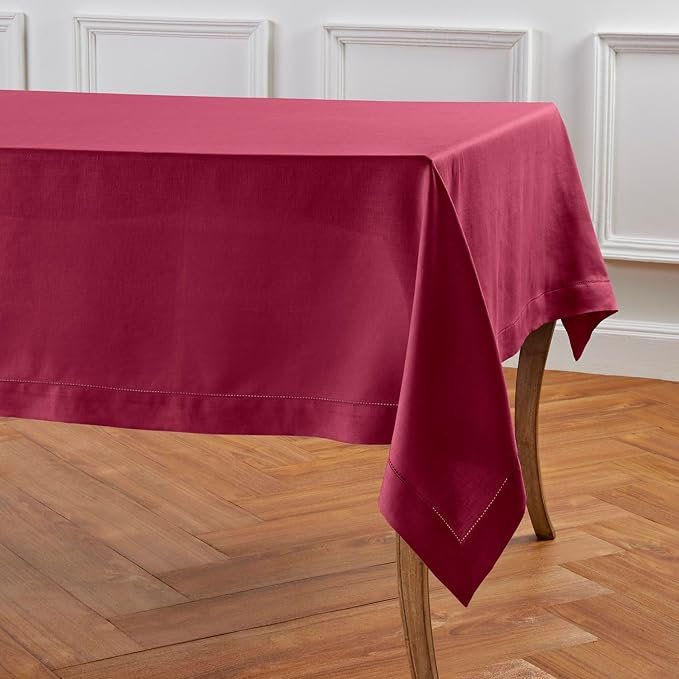
The Solino Home Pure Linen Tablecloth in Beet brings together natural fabric, traditional craftsmanship and a rich, warm colour that can transform the appearance of a dining table.
Made from 100% pure linen with a classic hemstitched border, it offers a more considered alternative to synthetic table coverings and heavily decorated seasonal designs.
The Beet colour is particularly attractive for autumn dining. Its deep, earthy red tone works naturally with wooden furniture, neutral ceramics, candlelight and the warmer colours associated with the changing seasons.
Yet this is not a tablecloth that needs to be packed away when autumn ends.
Its understated styling makes it equally suitable for Christmas gatherings, family celebrations and everyday meals where a beautifully dressed table adds something to the occasion.
The 60 × 132-inch version provides generous coverage for a long rectangular dining table, while the natural characteristics of linen create a softer, more relaxed appearance than a perfectly smooth synthetic cloth.
There are practical considerations, however.
Pure linen creases, requires thoughtful laundering and will not offer the wipe-clean convenience of a coated table covering.
For someone who values natural materials and timeless design, these characteristics may be perfectly acceptable. For others, they could make the tablecloth less practical for daily use.
Understanding both sides is important when choosing a table covering intended to remain useful well beyond a single season.
Why it works in a beautifully styled dining room
A tablecloth can have a surprisingly large influence on the appearance of a dining space.
Because it covers such a substantial surface, the fabric and colour help establish the character of the entire table.
A neutral cloth can create a quiet background, while a richly coloured one brings warmth and definition.
The Solino Home Classic Hemstitch Tablecloth takes the second approach without relying on bold patterns or elaborate decoration.
Its Beet colour provides a strong visual foundation, but the simple design allows dinnerware, glassware and centrepieces to remain the focus.
This is particularly useful when arranging a table for guests.
Instead of combining numerous decorative items to create an atmosphere, the cloth itself supplies much of the colour.
Cream-coloured plates, clear glassware and natural wood accessories would sit comfortably against the darker fabric.
For a more formal arrangement, white tableware, polished cutlery and simple candleholders could create an elegant contrast.
The tablecloth also works with more relaxed dining settings.
A wooden serving board, a ceramic jug and a few seasonal branches may be enough to create a welcoming table.
This versatility is one of its strongest qualities.
Rather than depending on a particular decorative theme, the design draws its appeal from the linen texture, generous drape and carefully finished border.
For BuyZola, that combination of natural material and restrained styling is especially appealing.
The appeal of 100% pure linen
The defining feature of this Solino Home tablecloth is its fabric.
The manufacturer specifies 100% pure linen, a textile made from flax fibres.
Linen has been used for household textiles for generations because of its distinctive texture, absorbency and natural appearance.
Unlike many synthetic fabrics, linen does not generally have an artificially smooth or glossy surface.
Its woven structure creates subtle variations that give the material character.
These variations are part of the appeal.
A linen tablecloth can look attractive even when it is not perfectly pressed, because gentle folds and natural creases contribute to a relaxed, lived-in appearance.
This makes it particularly suitable for interiors that favour honest materials such as wood, stone, ceramics and natural fibres.
Linen also tends to become softer with use and appropriate laundering.
A newly purchased cloth may feel comparatively crisp, while repeated washing can gradually produce a more relaxed handle.
That development is one reason people choose linen for items intended to be used regularly rather than kept purely for decoration.
However, natural fabric requires different expectations from a synthetic tablecloth.
Linen can wrinkle, shrink if improperly cared for and absorb spills.
Its appeal is not based on being maintenance-free.
It is based on the texture, appearance and character of the material.
For someone who appreciates natural textiles, these qualities often matter more than achieving a permanently flawless surface.
Classic hemstitch detailing
The hemstitched border is the feature that gives this tablecloth its distinctive finishing detail.
Hemstitching is a traditional decorative technique that creates a subtle openwork effect along the edge of a fabric.
Rather than introducing an elaborate pattern across the whole tablecloth, it provides a restrained detail around the perimeter.
On the Solino Home design, the stitching complements the simplicity of the linen.
It creates a more finished appearance without overpowering the natural texture of the material.
This is particularly effective on a large dining table.
When the cloth hangs over the edges, the border becomes more visible and helps define the fabric’s shape.
The detailing also makes the tablecloth suitable for more formal occasions.
A plain linen cloth can sometimes feel extremely casual, particularly when styled with everyday tableware.
The hemstitched edge provides just enough decoration to make the arrangement feel more deliberate.
Solino Home describes the collection as handcrafted by skilled artisans.
That emphasis on traditional finishing is consistent with the overall design.
However, handcrafted textiles should not be expected to have the mechanical uniformity of mass-produced synthetic products.
Small variations in the fabric or stitching can be part of their character.
For someone seeking understated decoration rather than embroidery, lace or printed patterns, the classic hemstitch is a particularly appealing choice.
Why the Beet colour works so well in autumn
The Beet colour is one of the main reasons to consider this particular version.
It offers a deeper, warmer alternative to bright red or ordinary neutral table linen.
That makes it a natural fit for autumn dining.
During October and November, the colour can complement seasonal arrangements using foliage, pumpkins, natural greenery and warm-toned ceramics.
It also pairs well with wooden dining tables.
The warmth of the fabric creates an inviting appearance without requiring the table to be heavily decorated.
For Thanksgiving, Beet provides a rich background for cream dinnerware, brass-toned accessories and simple natural centrepieces.
The result can feel seasonal without depending on printed leaves, novelty decorations or obvious holiday motifs.
The same cloth can then be used for Christmas.
Deep red linen works comfortably with evergreen foliage, white candles and more formal table settings.
That makes the colour considerably more versatile than a tablecloth designed around one particular holiday.
Outside the festive season, the cloth can also introduce warmth to a neutral dining room.
This is particularly useful in spaces dominated by white walls, pale furniture or understated modern finishes.
A single textile can provide contrast without permanently changing the room.
Naturally, colour preferences are personal.
Beet is a substantial visual statement, and it may not suit every interior.
For homes built around cool blues, pale greys or very light Scandinavian-style palettes, a softer linen colour may be easier to coordinate.
But for those who enjoy warm, rich colours, the Beet finish has lasting appeal.
Understanding the 60 × 132-inch size
Choosing the correct tablecloth size is just as important as choosing the fabric and colour.
The version considered here measures 60 inches wide by 132 inches long.
That is a generous rectangular size intended for a long dining table.
A tablecloth should normally extend beyond the tabletop so that the fabric hangs naturally over the edges.
This hanging section is called the drop.
For everyday dining, a drop of approximately 8 to 12 inches on each side is a useful starting point, although personal preferences and table height may influence the choice.
With a 60-inch width, that would suit a tabletop approximately 36 to 44 inches wide.
Along its 132-inch length, the same drop would suit a table approximately 108 to 116 inches long.
These are useful planning measurements rather than strict requirements.
A shorter table will produce a longer overhang, while a wider table will have less fabric hanging down at the sides.
For example, placing a 132-inch cloth on a considerably shorter table may create a dramatic drop at each end.
That can look attractive for a formal gathering but may be inconvenient when guests are seated close to the corners.
It is also important to consider chairs.
An excessive overhang can catch against diners’ legs or become trapped beneath chair arms.
Before choosing this size, measure the table carefully.
Include both the length and width, then decide how much fabric you would like to hang over each edge.
Allow for the possibility of dimensional changes during laundering, particularly with natural linen.
A beautiful tablecloth becomes far more useful when its proportions suit the actual furniture.
What it feels like to use
Linen has a distinctive character that separates it from many conventional table coverings.
The fabric tends to drape naturally rather than producing the stiff appearance associated with some coated or heavily finished materials.
On a long rectangular dining table, this creates attractive folds at the corners and a softer appearance along the edges.
The hemstitched border provides a subtle finishing detail where the fabric hangs down.
For an everyday meal, the cloth can be arranged quite simply.
A few placemats, suitable dinnerware and a small centrepiece may be all that is needed.
For a special occasion, the same fabric can support a more elaborate arrangement.
Candles, serving dishes and coordinated napkins can be introduced without the cloth itself appearing overly decorative.
The fabric’s natural texture also changes the atmosphere of the table.
Glass, metal and glazed ceramics create smooth, reflective surfaces.
Linen introduces a softer visual contrast.
This can be particularly effective when a dining room contains substantial wooden furniture or hard flooring.
There is also a difference in handling.
A large pure linen tablecloth needs to be unfolded, positioned and smoothed carefully.
It will not necessarily lie perfectly flat straight from storage.
Some people appreciate this relaxed quality.
Others prefer the crisp, uniform appearance of polyester or treated table linen.
The best choice depends on whether natural texture is seen as an attraction or an inconvenience.
Everyday dining and special occasions
One of the strengths of this tablecloth is that it does not look exclusively formal.
The pure linen fabric gives it a traditional quality, while the simple border prevents it from feeling excessively ornate.
For everyday dining, it could be paired with practical ceramic plates, wooden serving accessories and ordinary glassware.
This would create a comfortable, welcoming table without looking like a formal event.
For birthdays, family gatherings and dinner parties, the arrangement can be made more elaborate.
The rich Beet colour is particularly effective with white or ivory dinnerware.
It also provides a strong background for clear glass, natural linen napkins or carefully chosen metallic accents.
Because the design is plain apart from its border, it offers flexibility in the choice of table accessories.
Patterned dishes can work against the fabric, while simple tableware creates a quieter result.
The long rectangular size is especially suitable for larger dining arrangements, provided the table dimensions are appropriate.
There is enough fabric to create a substantial, continuous surface beneath place settings and serving dishes.
That can make a large table feel more unified.
However, everyday use also means exposure to ordinary food and drink spills.
Anyone planning to use fine linen for every meal should consider how comfortable they are with regular laundering and stain treatment.
For some households, the tablecloth may be most practical for weekend meals and special occasions rather than remaining on the table continuously.
Coordinating with other table linens
Solino Home offers coordinating pieces in its Classic Hemstitch collection.
These include dinner napkins, placemats and table runners.
That provides an opportunity to create a consistent dining arrangement without relying on unrelated fabrics.
Matching napkins can produce a formal, coordinated look.
However, an entirely matching table is not the only option.
The deep Beet colour can also work with lighter natural linens.
Ivory or beige napkins, for example, could introduce contrast while maintaining the emphasis on natural fabric.
A simple table runner may be unnecessary when using a full tablecloth, but contrasting accessories can add visual interest.
The important point is not to overdecorate.
The tablecloth already contributes a substantial amount of colour and texture.
Too many competing accessories may make the arrangement feel crowded.
For autumn dining, a simple combination of natural foliage, understated plates and a few candles may be more effective than a complicated decorative scheme.
For festive occasions, evergreen branches and restrained metallic details can create a different atmosphere without changing the tablecloth.
This flexibility allows the fabric to remain useful through different seasons.
Caring for the linen properly
Pure linen deserves sensible care.
Solino Home recommends machine washing on a gentle cycle.
The manufacturer’s instructions also specify avoiding bleach, using a low tumble-dry setting when needed and ironing on a low setting as required.
Following these instructions is important for preserving the fabric and decorative border.
A large tablecloth should also have sufficient room inside the washing machine.
Overloading the drum can prevent the fabric from moving freely and may increase creasing.
It is sensible to wash richly coloured table linen separately from light fabrics, particularly during its first few washes.
After washing, the cloth should be handled carefully to avoid unnecessary distortion of the edges.
Linen naturally creases, so removing it promptly from the machine can help reduce heavily set folds.
For a relaxed everyday appearance, gentle creasing may be perfectly acceptable.
For a formal dining arrangement, ironing may be desirable.
The hemstitched border should be treated with care, avoiding unnecessary pulling or harsh mechanical handling.
Spills should be dealt with promptly using methods suitable for the fabric and the substance involved.
Abrasive scrubbing or aggressive stain removers may damage fibres or affect the colour.
The most useful approach is to follow the care label and avoid assuming that linen behaves like a wipe-clean synthetic table covering.
With appropriate care, the cloth is designed to soften and develop character through regular use.
The drawbacks
The Solino Home Pure Linen Tablecloth has plenty of appeal, but its natural material and generous dimensions introduce several practical limitations.
These deserve particular attention because a tablecloth is an item that may be washed, handled and exposed to spills repeatedly.
The first drawback is that pure linen wrinkles naturally.
For many people, gentle creasing is part of linen’s appeal.
However, someone expecting a completely smooth dining table may find the fabric frustrating.
Even after careful laundering and ironing, folds can develop when the cloth is stored, handled or placed on the table.
The larger the tablecloth, the more fabric must be managed.
A 60 × 132-inch cloth provides generous coverage, but it also creates a substantial amount of material to smooth and arrange.
If the preferred appearance is crisp and formal, ironing may become a regular part of preparation.
This is particularly relevant before special occasions.
A freshly laundered cloth may still require attention before guests arrive.
For someone who dislikes ironing, a more crease-resistant fabric may be more convenient.
Linen is best chosen with the understanding that its natural texture is part of the design.
Shrinkage is another important consideration.
Linen is a natural textile and can change dimension during laundering.
The degree of shrinkage depends on the fabric’s finishing, washing conditions and drying method.
Solino Home provides specific care instructions, and these should be followed carefully.
However, buyers should not assume that the cloth will remain at precisely its original dimensions after every wash.
This matters when selecting a size.
A tablecloth that initially has only a small overhang may become less satisfactory if it shrinks.
The 60 × 132-inch version should therefore be chosen with enough allowance for a comfortable drop.
A buyer should avoid selecting dimensions that leave absolutely no margin.
High temperatures and unsuitable laundering practices can increase the risk of unwanted dimensional changes.
For a fitted or carefully styled dining arrangement, shrinkage can be more than a minor cosmetic issue.
It may affect whether the cloth continues to cover the table as intended.
The large size will not suit every dining table.
A 132-inch length is generous.
That makes it attractive for long dining tables, but potentially impractical for smaller furniture.
On a short table, the fabric could hang too low at the ends.
This may interfere with seating or create folds that are easily caught.
Excessive overhang can also increase the likelihood of someone pulling the cloth accidentally.
Conversely, a particularly wide dining table may not provide enough drop along the sides.
The 60-inch width is therefore just as important as the length.
It would be a mistake to choose this version simply because it looks attractive in a product photograph.
The actual dining table must be measured.
The desired drop should then be calculated before purchasing.
For a smaller table, another size from the collection may be considerably more practical.
The fabric is not waterproof or wipe-clean.
This is one of the clearest differences between natural linen and a coated table covering.
Linen is absorbent.
Spilled water, wine, sauces or cooking oils can penetrate the fibres rather than remaining on the surface.
That means spills may require prompt attention and subsequent laundering.
For a household with young children, frequent informal meals or a busy dining table, this could become inconvenient.
A plastic-coated or stain-resistant tablecloth may provide easier everyday maintenance.
The Solino Home linen is better suited to someone who values the appearance of natural fabric and is comfortable caring for it.
It should not be purchased with the expectation that ordinary spills can always be wiped away without leaving a trace.
Food and drink stains may be difficult to remove completely.
A rich Beet-coloured tablecloth provides an attractive background for dining, but it is still vulnerable to staining.
Oil, wine, coffee, sauces and strongly coloured foods can leave marks on natural fibres.
Some stains are relatively easy to address when treated promptly.
Others may require careful treatment or prove difficult to remove entirely.
Aggressive stain removers can introduce further problems, particularly when working with a dyed fabric.
Bleach is specifically discouraged by the manufacturer’s care instructions.
That limits the cleaning methods available.
A buyer who expects to use the tablecloth for frequent family meals should be realistic about the possibility of staining over time.
The fabric can remain attractive with sensible care, but there is no guarantee that every spill will disappear completely.
The Beet colour may appear different in person.
Product photographs are influenced by lighting, camera settings and the display used to view them.
A deep red or burgundy-toned textile may look warmer, cooler, lighter or darker depending on those conditions.
The surrounding furniture and room lighting can also influence how the colour appears.
A fabric photographed in a bright studio may look quite different under warm evening lighting.
This is particularly important for someone attempting to match existing curtains, upholstery or dining accessories.
The Beet shade may coordinate beautifully with warm natural materials but appear less harmonious in a room dominated by cooler colours.
Anyone requiring a precise colour match should be cautious about relying entirely on screen images.
The colour is an important part of the tablecloth’s appeal, but it should be chosen with realistic expectations.
The hemstitched border requires more careful handling than a plain hem.
The decorative stitching provides a refined finish, but it introduces an additional detail that must be considered during care.
Openwork stitching may be more vulnerable to snagging than a straightforward folded and sewn edge.
Jewellery, rough surfaces or careless handling could potentially catch the border.
The fabric should therefore be handled thoughtfully during laundering, ironing and storage.
This does not make the design excessively delicate, but it does mean that the decorative finish deserves attention.
A household seeking an especially robust table covering for heavy everyday use may prefer a simpler construction.
The hemstitch is best appreciated as a traditional decorative feature rather than treated as a completely maintenance-free edge.
Pure linen has a different texture from smooth synthetic fabric.
Some people love the irregularity and relaxed character of linen.
Others prefer a uniformly soft, smooth and crease-resistant surface.
The Solino Home tablecloth should not be expected to feel identical to polyester, cotton sateen or heavily finished synthetic table linen.
Linen can initially feel comparatively crisp.
It generally becomes softer with suitable use and laundering, but that process takes time.
The natural weave may also contain small variations in texture.
These are not automatically defects.
They are part of the material’s character.
However, a buyer who wants a perfectly even, polished surface may find the fabric less appealing than expected.
The decision comes down to whether natural texture is seen as desirable.
The tablecloth needs more storage space than a smaller covering.
The 60 × 132-inch size contains a substantial amount of fabric.
When folded, it requires a suitable place where it can be stored cleanly and without unnecessary pressure.
Large folds may leave visible creases.
This can mean ironing or steaming is required before the next special occasion, subject to the manufacturer’s care instructions.
For someone who uses tablecloths only occasionally, the preparation involved may seem disproportionate.
The cloth may also be more cumbersome to wash and fold than a smaller everyday table covering.
Two people may find it easier to fold a large linen cloth neatly.
This is a minor issue for a household with sufficient storage and laundry space, but it is still worth considering.
It may not be the most practical choice for daily family dining.
A pure linen cloth looks attractive, but appearance is not the only consideration.
Families with young children may prefer a surface that can be cleaned rapidly between meals.
The same applies to households where the dining table is used for homework, crafts or other activities.
A fine linen tablecloth can become an inconvenience if it must be removed repeatedly to protect it from stains or accidental damage.
For those circumstances, a durable everyday covering or washable placemats may be more practical.
The Solino Home cloth may be better reserved for meals where its appearance adds genuine enjoyment.
That could mean weekend dining, family gatherings or special occasions rather than continuous daily use.
The best choice is not always the most decorative option.
It is the option that suits the way the table is actually used.
The Beet colour is less neutral than many alternatives.
Its rich tone is one of the tablecloth’s greatest attractions.
However, strong colours inevitably place some limits on coordination.
A white, ivory or natural linen cloth can work with almost any combination of dinnerware and seasonal accessories.
Beet makes a more definite statement.
Certain colours may compete with it, while delicate pastel arrangements may become less effective.
For autumn and Christmas dining, this is unlikely to be a disadvantage.
For spring and summer arrangements, the same deep colour may not provide the lighter atmosphere some people prefer.
The tablecloth can certainly be used throughout the year, but it is not as visually adaptable as a neutral version.
Someone who wants only one tablecloth for every occasion may prefer a softer colour.
The handcrafted nature of the collection means complete uniformity should not be assumed.
Solino Home describes the Classic Hemstitch collection as handcrafted.
Traditional textile production can introduce slight variations in stitching, fabric texture and finishing.
These may contribute to the character of the item.
However, buyers who expect every detail to have the exact mechanical regularity of an industrially produced product may be less comfortable with such variation.
It is sensible to inspect the tablecloth when it arrives.
The stitching should be sound, the fabric free from significant damage and the overall finish consistent with a well-made textile.
Handcraftsmanship is an attractive part of the product’s identity, but it should not be used as an excuse for genuine manufacturing faults.
Finally, not every household needs a pure linen tablecloth.
For someone who enjoys arranging a dining table, natural fabric can make the experience more satisfying.
The appearance, texture and drape are meaningful advantages.
However, a household that values quick cleaning above everything else may receive more practical benefit from an easy-care alternative.
Linen requires attention to washing, drying, possible shrinkage and storage.
The decorative border also benefits from careful handling.
These responsibilities are part of owning the product.
The Solino Home tablecloth makes most sense when the natural fabric and traditional detailing are genuinely appreciated.
Choosing it simply because it looks attractive in a photograph may lead to disappointment if the maintenance requirements do not suit everyday life.
Who it suits best
The Solino Home Pure Linen Tablecloth is particularly suitable for people who appreciate natural materials and understated dining-room design.
It should appeal to homeowners who enjoy creating a welcoming table without relying on heavily patterned or novelty decorations.
The Beet colour makes it especially attractive for autumn meals, Thanksgiving gatherings and Christmas entertaining.
It is also an appealing choice for anyone who prefers rich, warm colours and traditional textile craftsmanship.
The hemstitched border introduces enough detail to suit formal occasions, while the relaxed texture of linen allows it to work in more casual settings.
The 60 × 132-inch size is best suited to a long rectangular dining table where the fabric can hang comfortably without interfering with seating.
It may also appeal to people who enjoy coordinating natural table linens, ceramics and simple decorative accessories.
However, it is less suitable for households seeking a wipe-clean, crease-resistant or completely maintenance-free table covering.
Anyone choosing it should be comfortable with the natural behaviour of linen and the care required to keep the fabric looking attractive.
Is it worth the dining table space?
The Solino Home Pure Linen Tablecloth in Beet offers an attractive combination of natural fabric, traditional finishing and versatile design.
Its 100% pure linen construction gives it a character that is difficult to reproduce with ordinary synthetic table coverings.
The classic hemstitched border adds a refined detail without making the cloth look excessively formal.
The deep Beet colour is particularly appealing for autumn and festive dining, yet its plain design allows it to remain useful for other occasions throughout the year.
The generous 60 × 132-inch dimensions make it suitable for longer dining tables, provided the measurements and desired drop are carefully considered.
There are genuine drawbacks.
Linen wrinkles, may shrink during laundering and requires more thoughtful cleaning than a coated synthetic alternative.
The rich colour may also be less versatile than a neutral shade, while the decorative border deserves sensible handling.
Nevertheless, these considerations do not diminish the appeal of the material itself.
For someone who values natural textiles, thoughtful design and a beautifully arranged dining table, the Solino Home tablecloth offers something more enduring than a disposable seasonal decoration.
It is particularly well suited to homes where dining is treated as an occasion to enjoy, whether that means an ordinary family meal, a relaxed gathering with friends or a carefully prepared festive celebration.
For the right table and the right household, its rich colour, natural texture and traditional detailing make it a worthwhile addition to the dining room.
For more thoughtfully designed kitchen essentials, dining accessories and practical home finds, explore our Kitchen guides.
As an Amazon Associate I earn from qualifying purchases.