Moen Smart Shower 4-Outlet Digital Controller
As an Amazon Associate I earn from qualifying purchases.
The Moen Smart Shower 4-Outlet Digital Controller takes a very different approach from the familiar mechanical shower valve.
Instead of turning a conventional thermostatic handle until the water feels about right, the TS3304TB lets you choose the temperature digitally, select which shower outlets you want running, store favourite combinations and even start preparing the shower remotely.
For a bathroom built around a rain shower, hand shower, body sprays or several different outlets, that changes the shower from a simple mixer valve into a properly controlled system.
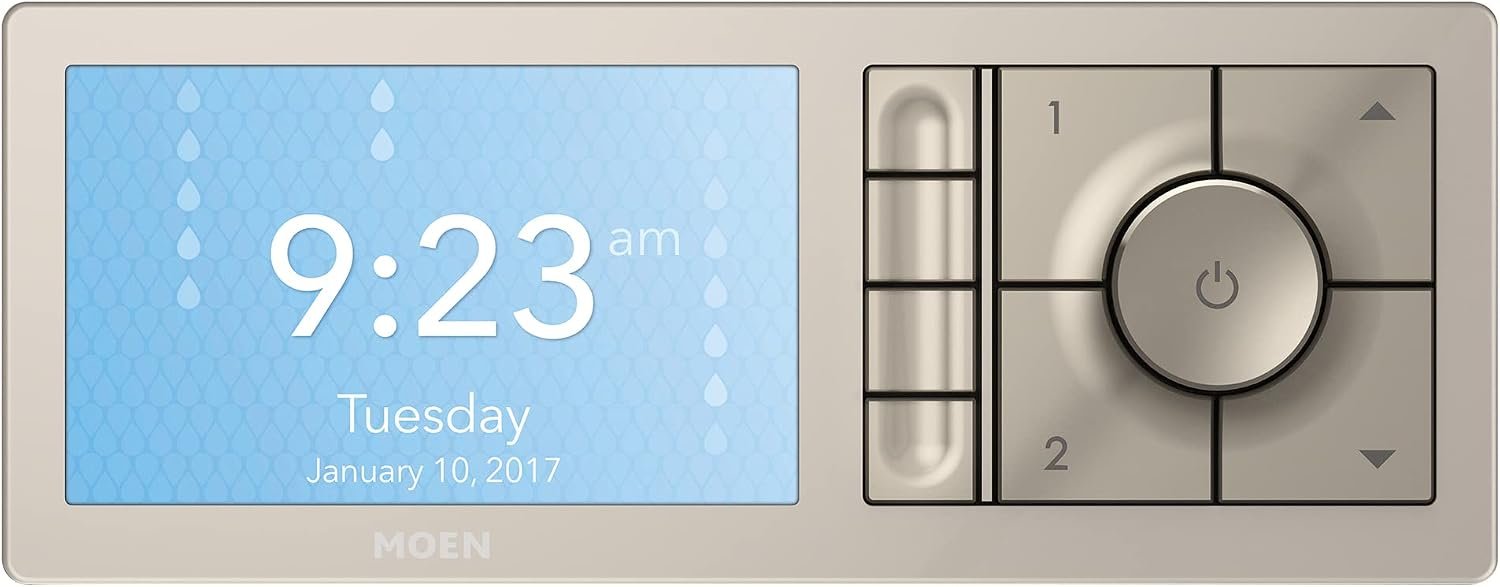
This particular Terra Beige controller is the visible part mounted inside the shower. Behind the scenes, it works with Moen’s separate S3104 four-outlet digital thermostatic valve, which actually manages the hot and cold water and distributes it to the selected outlets.
Why a digital shower is different
A conventional thermostatic shower valve is largely mechanical.
You turn one control for temperature, perhaps another for flow or outlet selection, and the valve reacts to changes in the hot and cold supplies.
The Moen system moves much of that control into electronics.
The controller gives you dedicated buttons for power, temperature and each of the four outlets, together with preset buttons and a 5-inch LCD display.
That makes the shower more repeatable.
Instead of remembering approximately where somebody likes the temperature handle positioned, a preferred setting can be stored and recalled.
That becomes especially useful in a household where different people want very different showers.
One person may favour a moderate temperature and overhead rain shower.
Another may prefer a warmer setting with a hand shower and body sprays running together.
The system can remember those combinations rather than asking everybody to rebuild the shower settings manually each time.
Precise temperature control
Temperature control is one of the strongest reasons for choosing a digital system.
Moen uses a digital thermostatic valve, and the controller allows the temperature to be altered electronically rather than through a conventional rotating mixer.
The factory maximum temperature is set to 115°F / 46°C, while the app can adjust the maximum up to 120°F / 49°C.
That does not mean everybody should simply raise the limit.
A maximum-temperature setting is an important safety feature, particularly in homes with children, older people or anyone more vulnerable to scalding.
The useful part is that the system gives the household control over that limit rather than treating temperature as an imprecise position on a dial.
Once you have found the shower temperature you prefer, reproducing it becomes much easier.
Four outlets change what the shower can do
The TS3304TB is specifically designed for Moen’s four-outlet system.
Those outlets can be connected to compatible shower fittings such as a conventional showerhead, rain shower, hand shower or body sprays.
The controller then lets you decide which outlets are active.
That makes the system particularly well suited to larger walk-in showers where several types of water delivery are part of the design.
For example, one outlet might feed the overhead rain shower.
Another could supply a hand shower.
The remaining two could be used for body sprays or another showerhead arrangement.
The important difference is that those functions are being managed centrally rather than requiring a collection of separate mechanical controls covering the wall.
What it feels like to use
The controller is designed to remain relatively simple despite what is happening behind it.
You have an LCD screen and soft-touch buttons rather than a large smartphone-style touchscreen.
Moen specifically describes the display as a 5-inch non-touch LCD, with separate physical controls for temperature, power, outlets and presets.
I actually think that approach makes sense in a shower.
Wet hands and touchscreens are not always the happiest combination.
A clearly defined button is easier to operate when your hands are wet and you already know where the function sits.
The controller measures roughly 8 11/16 inches wide by 3 3/8 inches high, so it has a noticeable presence on the shower wall without becoming an enormous control panel.
The Terra Beige finish also makes it visually very different from the usual chrome or black shower control.
For a bathroom where fittings and finishes have been chosen carefully, that could be an advantage.
Presets make the system personal
The controller itself provides two presets, while the smartphone app expands the system to 12 presets in total.
That is where the smart element becomes genuinely useful.
A preset can combine a preferred temperature with a particular selection of outlets.
So instead of beginning from zero each time, the system can recall a familiar shower arrangement.
For a couple, the two physical presets on the controller may already cover the most frequently used settings.
A larger household can make greater use of the additional app presets.
This is a far more practical use of smart-home technology than simply giving an ordinary shower a phone app.
The technology is remembering settings that would otherwise have to be recreated manually.
Remote activation and warm-up
The Moen app allows the shower to be activated remotely.
There is also a Warm-Up and Pause feature.
The idea is straightforward.
The shower begins warming to the chosen temperature, then pauses rather than continuing to send water down the drain indefinitely.
When you are ready, you resume the shower.
For a household where the bathroom is some distance from the bedroom, this can be much more convenient than turning on a shower, waiting for the hot water to arrive and repeatedly checking it by hand.
It also avoids the habit of leaving the shower running unnecessarily while you finish getting ready.
That is one of the more sensible smart-shower functions because it solves a very ordinary daily inconvenience.
App and voice control
Moen supports control through its smartphone app on iOS and Android, and the system is compatible with Amazon Alexa, Apple HomeKit/Siri and Google Assistant.
That can make the shower part of a wider smart-home setup.
Someone preparing for work could start the shower from another room.
A voice command could begin the warm-up process while clothes are being collected or breakfast cleared away.
But the controller remains fully usable inside the shower.
That is important.
A bathroom fitting should not become dependent on finding your phone every time you want hot water.
The app and voice functions are additions to the physical controller rather than replacements for it.
The hidden part matters just as much
This Amazon listing is for the TS3304TB controller only.
To create a working four-outlet system, it must be connected to the separate Moen S3104 four-outlet digital thermostatic valve.
That valve is the real plumbing heart of the system.
It uses 3/4-inch hot and cold inlets and 1/2-inch outlets, with four independently controlled outlets available.
Moen rates the system for up to approximately 14 gpm total flow at 45 psi, with up to 6 gpm through an individual outlet, assuming the water supply can provide that flow.
That is an important consideration.
A sophisticated digital controller cannot create water flow that the plumbing supply cannot deliver.
If several large shower outlets are intended to operate simultaneously, the incoming pipework, water pressure, hot-water supply and drainage all need to be considered as part of the complete bathroom design.
Installation needs planning
This is not a product I would treat as a simple replacement for an ordinary shower trim.
The S3104 valve needs to be installed where it remains accessible for servicing.
Moen specifies an access panel because the valve contains shut-offs, filters, electrical connections and serviceable components.
The valve can be located up to 30 ft away from the controller using the supplied data cable.
That gives the installer useful flexibility.
The digital valve could potentially sit in a service cupboard, accessible wall space or another suitable position rather than directly behind the controller.
That can make future maintenance much easier if it is planned properly during the bathroom installation.
Electrical power is part of the installation
Unlike a traditional shower mixer, the Moen Smart Shower requires permanent electrical power.
The valve needs a 120V GFCI-protected supply, and Moen recommends that the GFCI outlet be installed by a qualified electrician.
The controller itself communicates with the valve through the data cable.
There is also an optional battery backup kit that can allow operation during a power interruption.
That makes the electrical design part of the bathroom project from the beginning.
It is far easier to provide the required supply while walls are open than to discover after tiling that the system needs an accessible GFCI outlet near the digital valve.
Water supply deserves equal attention
A four-outlet digital shower can potentially move a considerable amount of water.
Moen states that the S3104 uses 3/4-inch inlet connections, rather than the smaller supply arrangement found on many simple shower installations.
That should immediately tell an experienced installer that this is not simply a matter of fitting four outlets and expecting the existing supply to cope.
Running a rain shower and several body sprays together places very different demands on a system than operating one modest showerhead.
Available pressure and flow need checking.
The hot-water system needs enough capacity.
Pipe sizing matters.
And if several high-flow outlets are running simultaneously, the drainage also has to deal with the water being delivered.
Moen notes that standard hot-water systems can be used, but for installations operating all four outlets, it recommends considering substantial hot-water capacity.
This is where proper bathroom planning matters more than the controller itself.
Maintenance has been considered
The digital valve includes accessible filter screens to help protect the internal mechanism from debris.
That is another reason the access panel is important.
Any valve can eventually need attention.
Debris can enter a water system after pipework changes, scale can accumulate depending on local water quality, and electronic components may one day need servicing.
A beautifully tiled bathroom is no place to discover that the main shower valve was permanently sealed into a wall.
Digital does not mean maintenance-free.
Good installation means making sophisticated equipment accessible without ruining the finished bathroom if service is eventually required.
The drawbacks
The most important drawback is that this controller is not a complete shower.
The separate S3104 digital thermostatic valve is essential, and showerheads, hand showers, body sprays and other fittings are also purchased separately.
That distinction needs to be understood before buying.
The attractive wall controller is only one part of a much larger system.
If someone buys it expecting to remove an ordinary mechanical shower valve and simply wire this in its place, they are going to have a very different project from the one they imagined.
Installation is also significantly more involved than a conventional shower.
You need plumbing for the digital valve, appropriate pipes to the separate outlets, a data cable to the wall controller and a permanent GFCI electrical supply.
In an existing finished bathroom, that could mean opening walls or undertaking substantial refurbishment.
This is therefore far easier to justify during a new bathroom installation or major renovation than as a casual weekend upgrade.
The four-outlet system also needs 3/4-inch supplies at the valve.
If the existing bathroom plumbing was designed around a basic low-flow shower, the available pipework and water supply may not support the sort of multi-outlet system this controller is designed to manage.
There is little point installing four beautiful shower outlets if the water pressure collapses when several are opened together.
A plumbing assessment should come before choosing the finished shower fittings.
Hot-water capacity can become another limitation.
Running an overhead shower, hand shower and body sprays together can use hot water very quickly.
A system that performs beautifully for five minutes but exhausts the household hot-water supply shortly afterwards is not well designed.
The digital controller cannot solve an undersized water heater.
The electrical requirement also adds complexity.
Traditional thermostatic shower valves can continue operating without mains electricity.
The Moen digital system depends on electrical power for normal operation, although an optional battery backup is available.
That introduces another system to install and another potential point of failure.
Some homeowners will be perfectly comfortable with that.
Others deliberately prefer bathroom fittings that remain as mechanically simple as possible.
The need for an access panel should not be overlooked either.
Moen specifically requires access to the digital valve for servicing.
That may influence where the shower is positioned and how the surrounding walls, cupboard space or adjoining room are designed.
A clever installer can usually make the access unobtrusive.
But it needs planning before tiling, not afterwards.
The smart features are also geographically restricted.
Moen states that the Smart Shower system and app are supported for the United States and Canada, and the system has not been approved for use in other countries.
That is particularly important with a product sold online.
Someone outside those supported markets should not assume that importing the controller will give them the same app functionality, approvals or support.
The app and voice control add convenience but also create dependence on software and connected services.
The physical shower controller continues to provide the fundamental controls, which is reassuring, but some of the advanced functionality relies on the smart-home ecosystem remaining compatible.
Software evolves differently from brass valves and pipework.
A conventional shower mixer can remain unchanged for decades.
A connected shower introduces Wi-Fi, apps and voice-platform compatibility into something traditionally mechanical.
That does not make it a bad idea, but it is a genuine difference in ownership.
There is also a maximum temperature setting to consider.
The factory limit is 115°F, and the app can raise that to 120°F.
Increasing a shower’s maximum temperature should never be treated casually.
Anyone changing the setting needs to consider who uses the bathroom and the risk of scalding.
For households with children or vulnerable users, leaving the safer maximum in place may be far more sensible than using every adjustment simply because it is available.
The controller has two physical presets, with additional presets available through the app.
For most households that is probably enough.
But if several people want immediate button access to their own settings without using a phone, two buttons may feel limited.
Voice control is convenient as well, but personally identifiable household routines should not be built around the assumption that everyone wants a smart speaker listening nearby.
Some people will deliberately leave those integrations unused.
The finish is another practical consideration.
Terra Beige is distinctive and can work beautifully in a warm, modern bathroom, but it is less universally interchangeable than chrome or brushed nickel.
Because the controller is a prominent rectangular element on the shower wall, its appearance becomes part of the bathroom design.
It deserves choosing alongside the tiles and fittings rather than as an afterthought.
A further drawback is that the controller itself does not determine the final shower experience.
The actual feel of the water depends heavily on the outlets you pair with the valve.
A poor showerhead does not become wonderful simply because a digital controller turns it on.
Likewise, body sprays that are badly positioned remain badly positioned.
The Moen system gives excellent control over a properly designed shower.
It cannot compensate for poor bathroom layout.
There is also the possibility of overcomplicating what was previously simple.
For some people, walking into a shower and turning one thermostatic handle is exactly what they want.
They have no interest in presets, Wi-Fi, voice assistants or remotely warming the water.
For that household, the extra electronics, plumbing design and installation work may offer little practical benefit.
The Moen Smart Shower makes the most sense when the additional control will actually be used.
Finally, this is the kind of product where installer quality matters enormously.
A good digital shower fitted with sensible service access, properly sized supplies and correctly positioned outlets could be a pleasure to use for years.
The same equipment fitted without considering water flow, electrical access or future servicing could become frustrating very quickly.
The controller may be smart.
The installation still needs to be smarter.
Who it suits best
The Moen Smart Shower 4-Outlet Digital Controller makes the most sense for someone planning a new high-spec bathroom or substantial bathroom renovation.
It is particularly appropriate for a larger walk-in shower containing several different outlets.
A household where different people regularly use very different shower temperatures can make real use of the preset system.
Anyone who likes smart-home automation may also appreciate remote warm-up, app control and voice integration.
It could be particularly useful in an en-suite where starting the shower before entering the bathroom is genuinely convenient rather than simply a novelty.
But I would not regard it as the obvious choice for every bathroom.
A straightforward shower used by one or two people may be better served by a quality mechanical thermostatic valve.
Digital control becomes more compelling as the shower itself becomes more complex.
Is it worth the bathroom space?
The Moen Smart Shower 4-Outlet Digital Controller is a good example of technology changing something familiar in a meaningful way.
It is not simply putting a screen on a conventional shower valve.
Combined with the S3104 digital thermostatic valve, it can control four separate outlets, precise water temperature, saved presets, remote activation, warm-up and pause, app functions and compatible voice assistants.
For a carefully designed multi-outlet shower, those functions can make the bathroom easier and more consistent to use every day.
There is a substantial installation commitment behind the neat wall controller.
The separate valve, 3/4-inch supply requirements, electrical connection, service access and sufficient hot-water capacity all need to be considered before the tiles go anywhere near the wall.
That is why this is not really a gadget purchase.
It is part of the plumbing design of the bathroom.
But when the shower is being rebuilt anyway and the aim is to create something genuinely more capable than a normal shower mixer, Moen’s digital system offers an interesting combination of proper thermostatic plumbing and modern electronic control.
Explore more considered bathroom products in our Bathroom section.
As an Amazon Associate I earn from qualifying purchases.